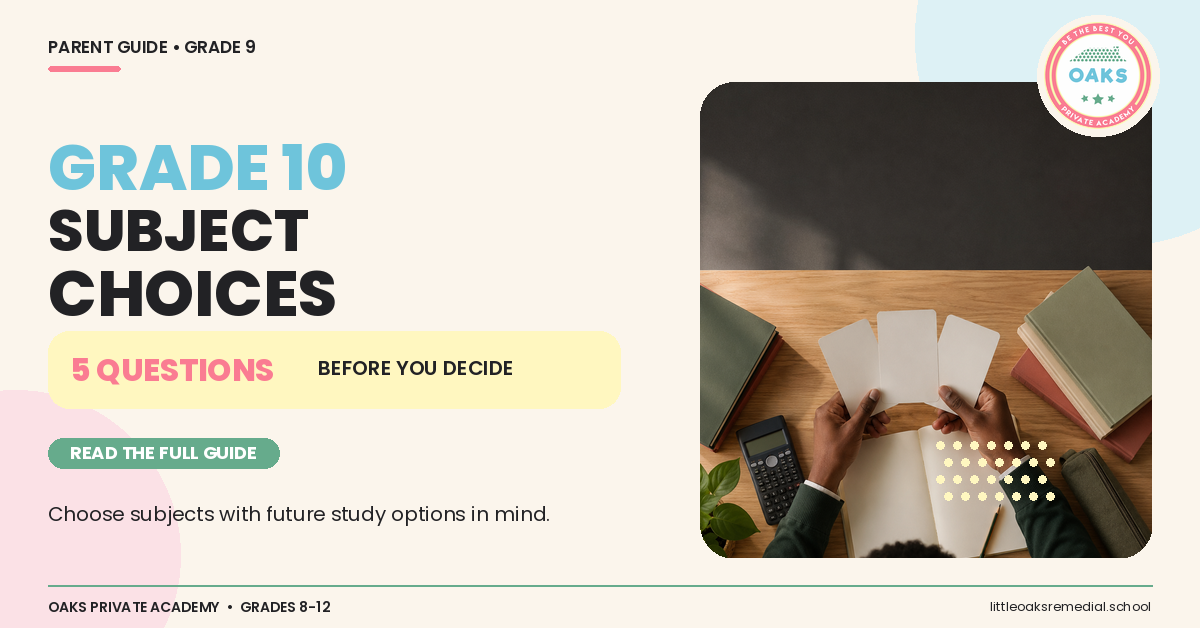
How to Choose Grade 10 Subjects in South Africa

A practical guide for Grade 9 learners and parents who want to protect future options without ignoring the learner in front of them. Choosing Grade 10 subjects in South Africa can feel like a decision about a timetable. In reality, it is a decision about future access. The subjects selected at the end of Grade 9 can influence which tertiary programmes, training routes and career fields remain open after matric. That does not mean every 14- or 15-year-old needs a complete career plan. It means the decision should be made with better questions: What is the learner good at? What do they enjoy enough to keep working at? Which subjects are required for possible next steps? What support helps them perform consistently?
The strongest subject package is not the one a friend chose or the one that sounds most impressive. It is the one that connects future requirements with the learner’s strengths, capacity and goals.

Why Grade 10 subject choices matter

The Department of Basic Education identifies Grade 9 as the point at which learners begin choosing subjects for Grades 10 to 12. A learner working towards the National Senior Certificate generally offers seven subjects: four compulsory subjects and three selected subjects from those available at the school.
Subject group What it normally includes
Four compulsory subjects Two official languages – one at Home Language level and one at First Additional Language level – plus Mathematics or Mathematical Literacy, and Life Orientation.
Three selected subjects Three optional subjects chosen from the approved subjects that the school is registered, resourced and able to offer.
Source note: Department of Basic Education, Subject Choice and Career Pathing.

Begin with possible destinations, not just favourite subjects

A learner does not need to know exactly what job they want. It is still useful to identify two or three broad directions – for example health sciences, business, design, technology, education, a trade, hospitality or entrepreneurship. Families can then check the entrance requirements for relevant universities, colleges, TVET programmes and other post-school routes. This step matters because a subject that earns admission points may not meet a specific programme prerequisite. A course may require Mathematics rather than Mathematical Literacy, a particular science subject, a language level, or a minimum achievement percentage. Requirements differ between institutions and can change, so check the latest official prospectus instead of relying on hearsay.

Understand Mathematics and Mathematical Literacy

The choice between Mathematics and Mathematical Literacy is often treated as a judgement about intelligence. It should be treated as an access decision. Mathematics is commonly required for programmes such as engineering and is often required or preferred for science, technology and some commerce fields. Mathematical Literacy focuses on applying mathematical thinking to real-life contexts and may be the more appropriate choice for many other routes. The right question is not simply, ‘Which subject is easier?’ Ask, ‘Which future options require Mathematics, and can the learner realistically sustain the work needed to meet those requirements?’ A subject only protects an option if the learner can engage with it and achieve the necessary result.

Choose for the learner – not for friends, status or pressure

Teenagers naturally compare their choices with their friends. Parents may also carry strong ideas about which subjects look prestigious. Neither should drive the final decision. Friends can move schools, change interests or choose different post-school routes. The learner is the person who must complete the assignments, assessments and examinations over the next three years. A good subject package should be challenging without being disconnected from the learner’s abilities. It should create enough stretch for growth while remaining realistic enough for the learner to build confidence, consistency and usable results.

Consider how the learner works

Marks are important, but they are not the whole picture. Look at patterns. Does the learner understand a subject but struggle to finish under time pressure? Do they lose track when instructions have several steps? Are they stronger in practical application than long theoretical tasks? Does anxiety affect tests? Is sustained attention difficult in a large class? For learners with ADHD, autism, anxiety or another learning difference, subject choice should include the environment and support available. This is not about lowering expectations. It is about understanding what conditions help the learner demonstrate what they know, take responsibility and make steady progress.

Check the school’s actual subject offering and support

Schools do not all offer the same optional subjects, combinations or timetable blocks. Before making a final choice, ask for the current subject list and confirm which combinations can be scheduled together. Also ask how the school monitors progress, communicates concerns and supports a learner who begins to fall behind. If a learner is moving to a new school, compare the curriculum, assessment arrangements and subject availability before assuming that the existing package can continue unchanged.

Five common subject-choice mistakes

Following friends

Friendship can make a new phase feel safer, but it is not a career plan. Subject choices should still fit the learner’s interests and possible destinations.

Choosing for status

A subject package is not stronger because it sounds more academic. It is stronger when it leads somewhere useful and the learner can perform in it.

Ignoring entry requirements

Interest in a career is only the start. Check the exact subjects and achievement levels required by the institutions that offer the relevant course or training.

Assuming the decision can always be fixed later

The DBE notes that optional-subject changes may be possible in Grades 10 and 11. In practice, timing, school policy, timetable space and the amount of content to catch up can make a late change difficult. A thoughtful first decision is still valuable.

Letting one report define the learner

One weak term should prompt investigation, not a permanent label. Look at longer-term patterns, teacher feedback, work habits, assessment conditions and whether the learner understands the underlying concepts.

A practical family conversation

Set aside an hour when nobody is rushing. Ask the learner to bring their latest reports, the school’s subject list and any information they have found about possible careers or courses. Then work through these questions:

Which subjects do you understand most naturally, and which ones are you willing to work harder at?

Which broad careers or industries interest you at the moment?

Which subjects are compulsory for those routes?

What do your marks and teacher feedback show over time?

What type of classroom, explanation and support helps you perform?

Which choice keeps useful options open without setting you up for constant failure?

The aim is not to force certainty. It is to make a considered choice with enough evidence to explain why it makes sense now.

Frequently asked questions

How many subjects do Grade 10 learners take in South Africa?

Learners working towards the National Senior Certificate generally take seven subjects: four compulsory subjects and three selected subjects, subject to the school’s approved offering and assessment arrangements.

Can Grade 10 subjects be changed later?

Changes may be possible, particularly in Grades 10 and 11, but school rules, timetables, deadlines and missed curriculum content matter. Discuss a change with the school as early as possible.

What if my child does not know what career they want?

Choose broad possibilities rather than one job title. Identify likely fields, check common entrance requirements and protect useful options while selecting subjects the learner can realistically sustain.

Does Mathematical Literacy mean a learner cannot be successful?

No. Mathematical Literacy can support many successful study, work and entrepreneurial routes. It does, however, affect access to programmes that specifically require Mathematics, so the decision should be informed.

Is the most academic-looking package always the best choice?

No. The best package is the one that aligns with the learner’s strengths, future requirements and ability to produce consistent results.

Subject choices should create direction – not panic

Oaks Private Academy supports Grades 8-12 in a smaller, mature environment where subject, learning and pathway decisions can be discussed around the individual learner. To ask about our CAPS, TOC, Academic and Pathway options, arrange a conversation with the Academy. [INSERT WEBSITE LINK]

Related Posts

A practical guide for Grade 9 learners and parents who want to protect future options without ignoring the learner in front of them. Choosing Grade 10 subjects in South Africa can feel like a decision about a timetable. In reality, it is a decision about future access. The subjects selected at the end of Grade 9 can influence which tertiary programmes, training routes and career fields remain open after matric. That does not mean every 14- or 15-year-old needs a complete career plan. It means the decision should be made with better questions: What is the learner good at? What do they enjoy enough to keep working at? Which subjects are required for possible next steps? What support helps them perform consistently?
The strongest subject package is not the one a friend chose or the one that sounds most impressive. It is the one that connects future requirements with the learner’s strengths, capacity and goals.

Why Grade 10 subject choices matter

The Department of Basic Education identifies Grade 9 as the point at which learners begin choosing subjects for Grades 10 to 12. A learner working towards the National Senior Certificate generally offers seven subjects: four compulsory subjects and three selected subjects from those available at the school.
Subject group What it normally includes
Four compulsory subjects Two official languages – one at Home Language level and one at First Additional Language level – plus Mathematics or Mathematical Literacy, and Life Orientation.
Three selected subjects Three optional subjects chosen from the approved subjects that the school is registered, resourced and able to offer.
Source note: Department of Basic Education, Subject Choice and Career Pathing.

Begin with possible destinations, not just favourite subjects

A learner does not need to know exactly what job they want. It is still useful to identify two or three broad directions – for example health sciences, business, design, technology, education, a trade, hospitality or entrepreneurship. Families can then check the entrance requirements for relevant universities, colleges, TVET programmes and other post-school routes. This step matters because a subject that earns admission points may not meet a specific programme prerequisite. A course may require Mathematics rather than Mathematical Literacy, a particular science subject, a language level, or a minimum achievement percentage. Requirements differ between institutions and can change, so check the latest official prospectus instead of relying on hearsay.

Understand Mathematics and Mathematical Literacy

The choice between Mathematics and Mathematical Literacy is often treated as a judgement about intelligence. It should be treated as an access decision. Mathematics is commonly required for programmes such as engineering and is often required or preferred for science, technology and some commerce fields. Mathematical Literacy focuses on applying mathematical thinking to real-life contexts and may be the more appropriate choice for many other routes. The right question is not simply, ‘Which subject is easier?’ Ask, ‘Which future options require Mathematics, and can the learner realistically sustain the work needed to meet those requirements?’ A subject only protects an option if the learner can engage with it and achieve the necessary result.

Choose for the learner – not for friends, status or pressure

Teenagers naturally compare their choices with their friends. Parents may also carry strong ideas about which subjects look prestigious. Neither should drive the final decision. Friends can move schools, change interests or choose different post-school routes. The learner is the person who must complete the assignments, assessments and examinations over the next three years. A good subject package should be challenging without being disconnected from the learner’s abilities. It should create enough stretch for growth while remaining realistic enough for the learner to build confidence, consistency and usable results.

Consider how the learner works

Marks are important, but they are not the whole picture. Look at patterns. Does the learner understand a subject but struggle to finish under time pressure? Do they lose track when instructions have several steps? Are they stronger in practical application than long theoretical tasks? Does anxiety affect tests? Is sustained attention difficult in a large class? For learners with ADHD, autism, anxiety or another learning difference, subject choice should include the environment and support available. This is not about lowering expectations. It is about understanding what conditions help the learner demonstrate what they know, take responsibility and make steady progress.

Check the school’s actual subject offering and support

Schools do not all offer the same optional subjects, combinations or timetable blocks. Before making a final choice, ask for the current subject list and confirm which combinations can be scheduled together. Also ask how the school monitors progress, communicates concerns and supports a learner who begins to fall behind. If a learner is moving to a new school, compare the curriculum, assessment arrangements and subject availability before assuming that the existing package can continue unchanged.

Five common subject-choice mistakes

Following friends

Friendship can make a new phase feel safer, but it is not a career plan. Subject choices should still fit the learner’s interests and possible destinations.

Choosing for status

A subject package is not stronger because it sounds more academic. It is stronger when it leads somewhere useful and the learner can perform in it.

Ignoring entry requirements

Interest in a career is only the start. Check the exact subjects and achievement levels required by the institutions that offer the relevant course or training.

Assuming the decision can always be fixed later

The DBE notes that optional-subject changes may be possible in Grades 10 and 11. In practice, timing, school policy, timetable space and the amount of content to catch up can make a late change difficult. A thoughtful first decision is still valuable.

Letting one report define the learner

One weak term should prompt investigation, not a permanent label. Look at longer-term patterns, teacher feedback, work habits, assessment conditions and whether the learner understands the underlying concepts.

A practical family conversation

Set aside an hour when nobody is rushing. Ask the learner to bring their latest reports, the school’s subject list and any information they have found about possible careers or courses. Then work through these questions:

Which subjects do you understand most naturally, and which ones are you willing to work harder at?

Which broad careers or industries interest you at the moment?

Which subjects are compulsory for those routes?

What do your marks and teacher feedback show over time?

What type of classroom, explanation and support helps you perform?

Which choice keeps useful options open without setting you up for constant failure?

The aim is not to force certainty. It is to make a considered choice with enough evidence to explain why it makes sense now.

Frequently asked questions

How many subjects do Grade 10 learners take in South Africa?

Learners working towards the National Senior Certificate generally take seven subjects: four compulsory subjects and three selected subjects, subject to the school’s approved offering and assessment arrangements.

Can Grade 10 subjects be changed later?

Changes may be possible, particularly in Grades 10 and 11, but school rules, timetables, deadlines and missed curriculum content matter. Discuss a change with the school as early as possible.

What if my child does not know what career they want?

Choose broad possibilities rather than one job title. Identify likely fields, check common entrance requirements and protect useful options while selecting subjects the learner can realistically sustain.

Does Mathematical Literacy mean a learner cannot be successful?

No. Mathematical Literacy can support many successful study, work and entrepreneurial routes. It does, however, affect access to programmes that specifically require Mathematics, so the decision should be informed.

Is the most academic-looking package always the best choice?

No. The best package is the one that aligns with the learner’s strengths, future requirements and ability to produce consistent results.

Subject choices should create direction – not panic

Oaks Private Academy supports Grades 8-12 in a smaller, mature environment where subject, learning and pathway decisions can be discussed around the individual learner. To ask about our CAPS, TOC, Academic and Pathway options, arrange a conversation with the Academy. [INSERT WEBSITE LINK]