
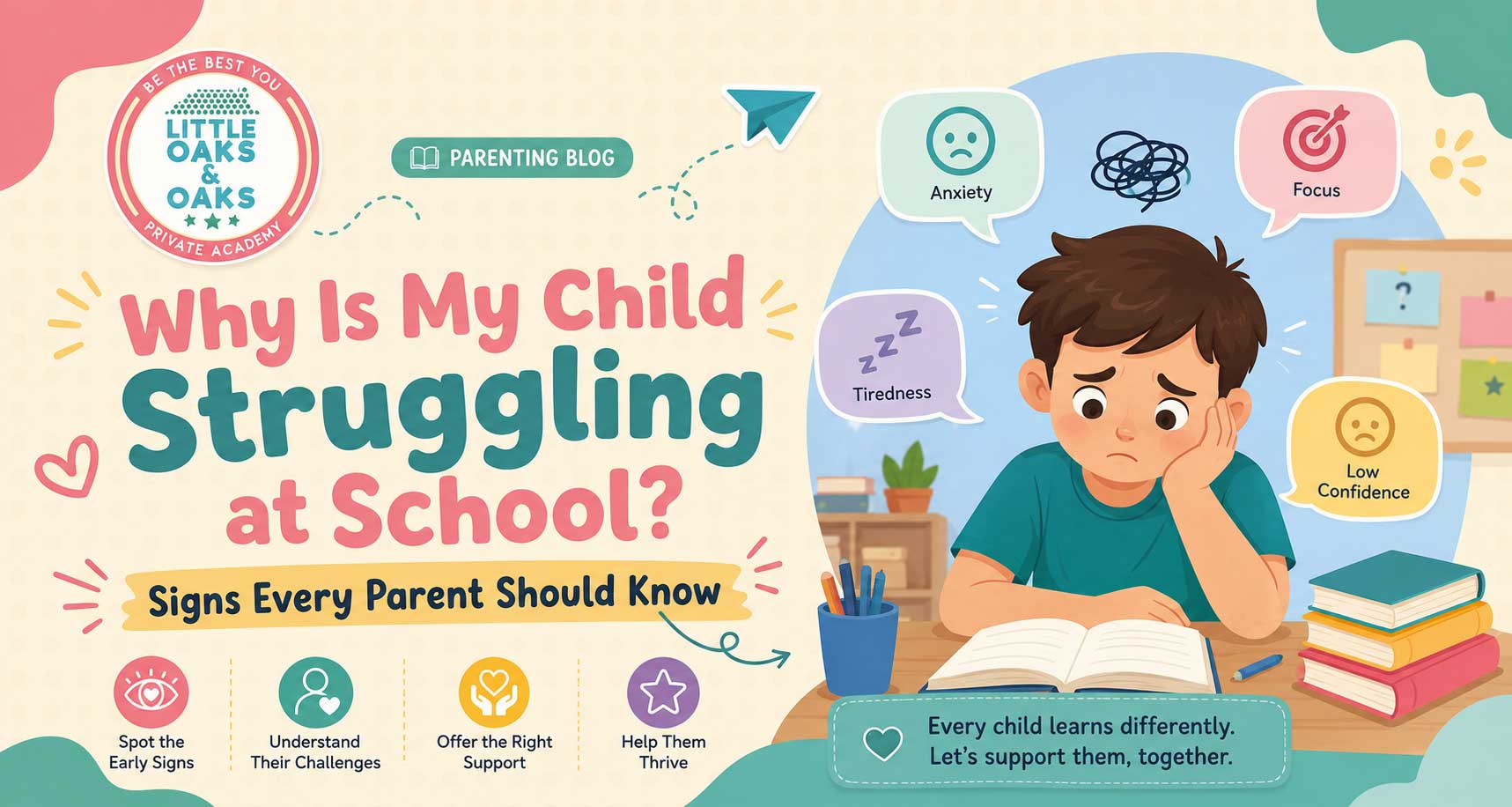
Why Is My Child Struggling at School? Signs Every Parent Should Know

Many parents ask this question quietly:
“Why is my child struggling at school when I know they are capable?”

It can be confusing and emotional. Your child may be trying hard, but still falling behind, avoiding schoolwork or losing confidence.

The truth is, struggling at school is often not about intelligence — it’s about understanding how your child learns.

Common signs your child may be struggling

Some children don’t openly say they are struggling. Instead, it shows in their behaviour.

Look out for signs like:

  • Avoiding homework or taking very long to complete simple tasks
  • Saying “I’m stupid” or “I can’t do this”
  • Getting frustrated or emotional during schoolwork
  • Difficulty reading, writing or understanding instructions
  • Losing focus quickly or being easily distracted
  • Complaining of headaches or tummy aches before school

These are not just “phases” — they are signals that your child may need support.

Why children struggle in school

There are several common reasons children struggle:

  1. Learning differences

Some children process information differently. This includes challenges like dyslexia, ADHD or slower processing speed.

  1. Classroom environment

Large classrooms can be overwhelming. Children who need more time or explanation may feel left behind.

  1. Emotional factors

Anxiety, low confidence or fear of failure can affect how a child learns.

  1. Gaps in understanding

If a child misses foundational concepts, future work becomes harder to understand.

It’s not laziness

One of the biggest misconceptions is that struggling children are lazy.

In most cases, children who are labelled “lazy” are actually:

  • Overwhelmed
  • Confused
  • Trying but not succeeding
  • Losing confidence

When children feel like they are constantly failing, they often stop trying.

What parents can do

If you suspect your child is struggling, here are some simple steps:

  • Have open, calm conversations with your child
  • Speak to teachers and ask specific questions
  • Break homework into smaller steps
  • Focus on effort, not just results
  • Avoid comparing your child to others

Most importantly, reassure your child that they are capable.

When to consider additional support

If your child continues to struggle despite effort, it may be time to consider extra support.

This could include:

  • Academic support or tutoring
  • Emotional support
  • A different learning environment that better suits your child

The right support can make a significant difference — not just academically, but emotionally.

Your child is not the problem.

Sometimes, the approach needs to change.

When children feel understood, supported and safe, they begin to rebuild confidence — and that’s when real progress starts.

At Little Oaks, we walk alongside each child and family, helping them find a path that works.

Related Posts

Many parents ask this question quietly:
“Why is my child struggling at school when I know they are capable?”

It can be confusing and emotional. Your child may be trying hard, but still falling behind, avoiding schoolwork or losing confidence.

The truth is, struggling at school is often not about intelligence — it’s about understanding how your child learns.

Common signs your child may be struggling

Some children don’t openly say they are struggling. Instead, it shows in their behaviour.

Look out for signs like:

  • Avoiding homework or taking very long to complete simple tasks
  • Saying “I’m stupid” or “I can’t do this”
  • Getting frustrated or emotional during schoolwork
  • Difficulty reading, writing or understanding instructions
  • Losing focus quickly or being easily distracted
  • Complaining of headaches or tummy aches before school

These are not just “phases” — they are signals that your child may need support.

Why children struggle in school

There are several common reasons children struggle:

  1. Learning differences

Some children process information differently. This includes challenges like dyslexia, ADHD or slower processing speed.

  1. Classroom environment

Large classrooms can be overwhelming. Children who need more time or explanation may feel left behind.

  1. Emotional factors

Anxiety, low confidence or fear of failure can affect how a child learns.

  1. Gaps in understanding

If a child misses foundational concepts, future work becomes harder to understand.

It’s not laziness

One of the biggest misconceptions is that struggling children are lazy.

In most cases, children who are labelled “lazy” are actually:

  • Overwhelmed
  • Confused
  • Trying but not succeeding
  • Losing confidence

When children feel like they are constantly failing, they often stop trying.

What parents can do

If you suspect your child is struggling, here are some simple steps:

  • Have open, calm conversations with your child
  • Speak to teachers and ask specific questions
  • Break homework into smaller steps
  • Focus on effort, not just results
  • Avoid comparing your child to others

Most importantly, reassure your child that they are capable.

When to consider additional support

If your child continues to struggle despite effort, it may be time to consider extra support.

This could include:

  • Academic support or tutoring
  • Emotional support
  • A different learning environment that better suits your child

The right support can make a significant difference — not just academically, but emotionally.

Your child is not the problem.

Sometimes, the approach needs to change.

When children feel understood, supported and safe, they begin to rebuild confidence — and that’s when real progress starts.

At Little Oaks, we walk alongside each child and family, helping them find a path that works.