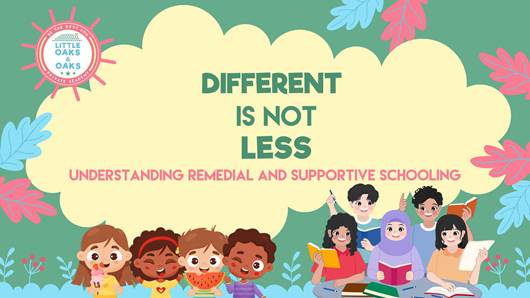
“Different is Not Less”: Understanding Remedial and Supportive Schooling in South Africa
Many parents hear the words “remedial schooling” and immediately feel anxious. Unfortunately, misconceptions about learning support have made parents fear labels that simply describe a child’s unique needs, not their potential.
This blog aims to clear the confusion and bring comfort: needing support does not make a child “less”. It simply means they learn in a way that requires a different approach.
1. What is remedial or supportive schooling?
Remedial or supportive schools are designed for children who struggle in mainstream environments due to:
Reading and writing challenges
Processing difficulties
Attention challenges
Slow working pace
Emotional overwhelm
Anxiety
These schools do not “lower standards”. They adapt teaching methods so children can progress with confidence.
2. Why mainstream classrooms aren’t always the right fit
In a class of 25 to 40 students, it is difficult for teachers to:
Slow down when a child is overwhelmed
Check for understanding often
Give one-on-one support
Provide emotional reassurance
Teach in different ways for different learning styles
Some children simply need an environment where they can be noticed, supported and guided at their pace.
3. What makes remedial environments effective?
Supportive schools provide:
Small classes (often fewer than 15 learners)
Individually paced work
Personal feedback
Multi-sensory teaching (learning through seeing, saying, touching, moving)
A calmer environment
Teachers trained to support learning differences
IEP’s developed
Children who once felt “behind” suddenly begin to flourish because the environment finally meets their needs.
4. Why “different” should never be seen as a disadvantage
Every child has strengths, creative, emotional, logical, practical, musical, social.
In remedial settings, these strengths are celebrated rather than overshadowed by challenges.
Children begin to learn:
“I am capable.”
“I am understood.”
“I can succeed in my own way.”
This shift in confidence often leads to academic progress too.
5. A school should fit the child, not the other way around
Supportive schooling is not a step backwards.
It is a step towards giving a child what they need to thrive.
6. Little Oaks and Oaks Private Academy approach
Little Oaks and Oaks Private Academy was created for children who learn differently.
Here, “different” is embraced.